
Eating in Japan is like a embarking on a treasure hunt in a vast, mysterious place. Explore the bizarre and wonderful products you can purchase and order. Marvel at the ingenious use of English on labels and menus. If you’re not sure what something on a menu is, be adventurous and try it anyway! Ask your waiter for his or her recommendation and just go with it! Most important, keep an open mind!
Shopping For Food
Until you get used to supermarkets and conbinis, you’ll probably spend a lot of time wandering the aisles trying to work out exactly what it is you’re looking at. Your main options for buying food are:
- Convenience stores (コンビニ): Lawson, Seven Eleven, Family Mart, Mini Stop: these stores are the backbone of Japan. They sell quite a lot of products, including alcohol, drinks, packaged meals, snacks, and stationery. You can find them everywhere and anywhere, and most are open 24/7, 365 days a year. They often have ATMs and also provide basic postal services. You can even pay your bills at them – everything from gas utilities to an airplane ticket to Seoul. Be aware that prices are a bit higher than elsewhere.
- Supermarkets (スーパ): Food culture in Japan emphasizes fresh, seasonal food, so look forward to enjoying high-quality fruits and vegetables from local farmers. Expect a smaller selection of frozen and canned options. Supermarkets also carry a good selection of household and hygiene products. Prices may be more expensive that what you’re used to, especially for foods like cheese and butter that aren’t as prevalent in a Japanese diet. Supermarkets in large shopping malls tend to have better selections than standalone stores.
There will come a time when you are searching for an ingredient that just isn’t sold in your area. Don’t despair! Think of it as less of a hassle and more of an adventure! The following stores offer a selection of foreign foods:
- Kaldi (Youme Town, Saga City)
- Jupiter (Mallage in Saga City)
- A-Price
- Costco (Ogori or Fukuoka) If you don’t have a car, consider using The Flying Pig or Hilo Market, both deliver goods from Costco.
If physical stores fail you, there are a number of online marketplaces:
- iHerb for lots of organic and health foods
- Rakuten for a hit-or-miss collection of various foreign items
- The Meat Guy sells high-quality meat and cheese which, can be hard to obtain in Japan
- The Foreign Buyer’s Club
- Indojin stocks many ingredients for Indian cuisine
Cooking at Home
Your apartment will have a refrigerator and a gas-burning stove. You might have a rice cooker and/or microwave provided by your board of education (BoE) or predecessor. Space might be limited (especially for those of us in Leopalace apartments!) so you might need to get creative with your prep and storage!
There is no need to bring any kind of appliance with you; the voltage is probably different, and you can purchase any products you are missing. Second-hand shops usually have a wide selection of goods in almost-new condition, and Amazon, Rakuten, and Costco provide wider selections if you desire.
For other kitchen implements check out Nitori, Seiyu, Daiso and other ¥100 shops.
Dining Out
You may even find that dining out is very inexpensive compared to what you are used to at home. If you love trying new foods and are willing to take a few risks when you get here you’ll be rewarded with a lot of great choices. For a sampling of what each area has to offer food-wise, check out the individual district pages. Most include a list of popular restaurants.
Non-Japanese restaurants in Saga include Italian, French, Indian, Korean, Jamaican, Chinese, and even Western fast food chains. Most pizza in Japan is quite different than what you’ll be used to (and expensive to boot), but good pizza can be found if you know where to look (shout out to Pizzeria Da Gino in Saga City!) Nagasaki and Fukuoka also have great options for Mexican or Chinese food!
Halal Eating
Groceries
Nepali Pasal Tosu
779-3 Taishomachi, Tosu, Saga
Telephone: 080-8576-1559
Prisak Halal & Grocery Shop
1 Chome-857-7 Hondorimachi, Tosu, Saga
Telephone: 080-6517-7879
Azhar Halal Shop
3-36-31-107 Hakozaki Higashi-ku, Fukuoka
Telephone: 092-651-4303
Restaurants
Zaeka – Indian and Pakistani cuisine
1-3-4 Maizuru Akebono Kopo 2F, Chuo-ku, Fukuoka
Telephone: 092-732-7513
Kebabooz – Sudanese cuisine
Daimyo 2-1-17, Chuo-ku, Fukuoka
Telephone: 092-716-9192
Bistro Bar Crescent – Moroccan cuisine (Note: link is not official web site)
2-1-25 Susenji, Nishi-ku, Fukuoka
Telephone: 092-807-8860
Fukuoka Now have a great guide that introduces a number of the Muslim-friendly establishments in the city of Fukuoka, along with maps to help you find them. Made with the assistance of the Fukuoka Masjid Al Nour Islamic Center, it covers three categories of businesses: those under Muslim management, those frequented by Muslim residents of Fukuoka, and those that sell halal foods.
Thanks to former Saga JET Ahmad and the Al Nour Islamic Center in Fukuoka for the helpful information!
Vegatarian and Vegan Eating
Avoiding meat in Japan is challenging but not impossible. For vegetarians and vegans, especially, it is important to be familiar with the phrases and kanji associated with food and nutrition. Learn these and you will be well equipped to maintain your lifestyle.
Thankfully, Saga has a Guide to Vegetarian Eating as of 2023 (in Japanese)
Public Enemy #1 – Fish
Fish and all things related are eaten frequently in Japan. It’s often difficult to spot fish in its various forms, as it is widely used in sauces and broths. However once you are able to identify what has fish and what doesn’t, it can be easily avoided (though it will limit food options). Note that Japanese people will not group fish with ‘meat’, so you must often be explicit when explaining your restrictions.
Important Words and Phrases
The words to explain your diet are fairly straightforward – ベジタリアン vejitarian or ヴィーガン vi-gan.
| “Can you make this without meat?” | 肉なしできますか。 Niku nashi dekimasu ka? |
| “Without ____ please.” | __なしでお願いします。 __ nashi de onegaishimasu |
| “I can’t eat fish or meat.” | 魚と肉が食べられません。 sakana to niku ga taberaremasen |
| “Is there meat in this?” | 肉が入っていますか。 niku ga haitteimasu ka? |
Food to Avoid
One classic Japanese food that you will unfortunately need to avoid here in Kyushu is ramen. While on Honshu you may be able to find a miso ramen with a vegetarian broth, the specialty in Kyushu is tonkotsu ramen made with a pork broth. A good alternative is udon, which is generally made with different types of soups and does not contain meat (be sure to confirm before you order).
Aside from noodles cooked in broths, you should also be wary of things like sauces served with fried tofu, eggplant, and tempura. Also watch out for miso soup, which in almost all cases is made with a fish stock and in Kyushu often contains shellfish.
Be on the lookout for chikuwa (竹輪), kamaboko (蒲鉾), and katsuo bushi (鰹節/かつお節), which may accompany dishes labeled vegetable only.
Shopping and Food Labels
Meat: 肉 / niku
Chicken: 鶏肉 / tori niku or kei niku
Fish: 魚/ sakana
Pork: 豚肉 / buta niku
Beef: 牛肉 / gyuu niku
Chikuwa: 竹輪 (processed fish cakes)
Katsuo Bushi: 鰹節 or かつお節 (bonito flakes)
Kamaboko: 蒲鉾 (fish paste)
Dashi: 出し / だし (soup stock made with fish/seaweed)
Bacon: ベーコン
Check out survivinginjapan for a more thorough look at Japanese food labels.
Dealing with Allergies
Food allergy information in Japan lists seven ingredients which are commonly used in food: eggs, milk, wheat, buckwheat, peanuts, shrimp and crab. Products containing these ingredients are required to be labeled.
Why these seven? According to the allergy handbook produced by the Japan Consumer Affairs Agency these seven allergens are the ones most likely to produce a severe reaction (think anaphylactic shock). In Japan eggs, milk, and wheat make up 70% of food allergies.
Below is a quick view of the seven most common allergens in Japan and their Japanese kanji:
| 乳 | 卵 | 小麦 | そば | 落花生 | えび | かに |
| Milk / Dairy | Egg | Wheat | Buckwheat | Peanuts / Tree Nuts | Shrimp | Crab |
For more in depth information on allergy information / labeling in Japan see the following posts:
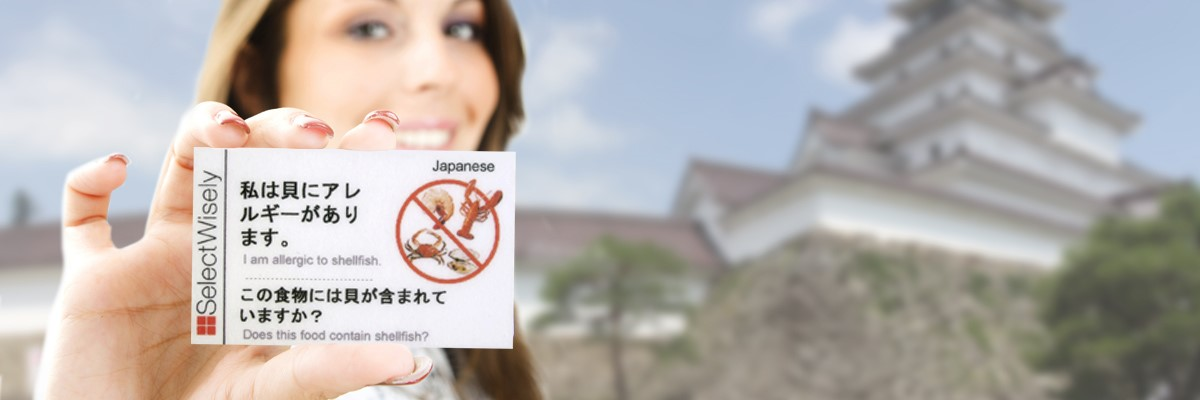
If you are uncomfortable with your language ability yet still want to be able to communicate important information regarding food or other medical allergies look into getting cards made by ‘Select Wisely‘. They are a company that makes travel translation cards for those with food allergies, gluten free celiac disease, diabetes, latex allergy, lactose intolerance, and asthma.
 Saga JET Programme